Resource
Net Zero Adaptation Finance: Climate Risk Screening for Carbon Projects
Funded by the Global Environment Facility and carried out in partnership with the Food and Agriculture Organization of the United Nations, the Net Zero Adaptation Finance (NZAF) project, led by Winrock International, aims to integrate climate change adaptation into carbon projects in the agriculture, forestry and other land use sector (AFOLU) sector in least developed countries. These countries rely heavily on AFOLU for their development but have historically received little financing for climate adaptation.
Key Outputs of the NZAF Project
- A tool for screening and mainstreaming adaptation in carbon project design and implementation
- Custom technical assistance and financial incentives made for project developers for eligible projects
- A long-term mechanism/fund for incentivizing adaptation action
- Best practices identified for integrating climate change adaptation into carbon projects
NZAF’s Climate Risk Screening Tool
Building from an existing tool designed for the Acumen Resilient Agriculture Fund, NZAF’s updated tool provides qualitative analysis of climate risks, identifies existing climate adaptation practices in the carbon project design, identifies potential for maladaptation, and identifies potential adaptation activity improvements for carbon projects. The tool both reduces risk from climate change to carbon projects and assesses how proposed projects can generate adaptation and resilience co-benefits in target communities.
Tool Features
- User-friendly, interactive online platform (tool will be Excel based until Fall of 2026)
- Assesses climate risk and socio-economic factors that compound vulnerability to climate risks for project geography using vetted data sources (no project/baseline climate risk)
- Analyzes project design and activities to identify how the project, as designed, could help communities/regions adapt to identified climate risks, while also assessing any potential maladaptation
- Identifies additional adaptation actions to address climate risks
- Provides qualitative analysis of how climate risks could impact project carbon benefits, project operations, commodities, communities, and ecosystems, and how the carbon project could mitigate negative impacts while building resilience
- Facilitates access to resources and technical assistance to increase climate adaptation integration into project design
The tool rates climate risk as high, medium, or low under three scenarios (figure 1), enabling the user to evaluate how selected adaptation actions reduce specific risks and informing carbon project design to improve resilience and generate co-benefits:
ASSESSMENT SCENARIOS
- No project (baseline)
- Post-project implementation
- Post-NAZF recommendations
The tool uses a suite of climate risk metrics drawn from vetted data sources including the FAOs Climate Risk Toolbox and WRI’s Aqueduct Water Risk Atlas looking at historical and projected data on temperature, precipitation, freshwater availability, flooding, soil health, disaster risk, and compounding socio-economic risk factors. Risks are rated as high, medium, or low and an analytic justification is provided for each ranking.
Assessing Impacts Across Key Carbon Project Categories
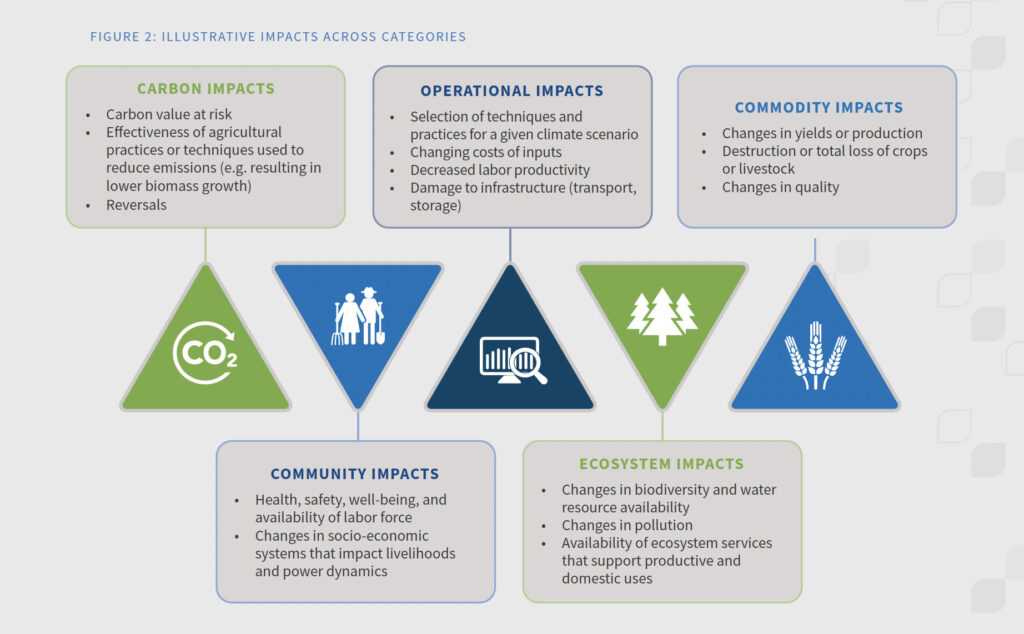
Once initial risk is assessed, NZAF’s tool provides a qualitative analysis of how climate risks may impact the assessed carbon project. Taking into consideration geographic locations, project scope (e.g. agroforestry, agricultural land management), activities and time horizon, NZAF’s tool analyzes climate impacts on carbon, operational impacts, commodities, community, and ecosystems. As with the risk assessment, the impact assessment is also conducted across all three phases of the analysis (figure 1).