Planting a forest across generations
This is the third installment of #WinrockResilienceStories, aimed at amplifying community voices and sharing innovative approaches, partnerships and solutions that strengthen rural resilience, improve environmental outcomes, and support both people and planet. This month, we’re featuring a case study published by ACR at Winrock International that spotlights how tree planting and carbon markets are helping rural landowners in the U.S. South diversify income while restoring ecosystems.
Planting a legacy in the Mississippi Alluvial Valley
Janie Cater’s grandfather, Grover C. Womack, first settled in Catahoula Parish, Louisiana in 1870. Establishing a family farm that operated for more than 100 years, generations of the Womack family were raised on the land. “It’s where everything happened,” Cater explained. “It’s where we rode horses, went hunting and walked with the children. I consider it a family legacy.”
Just over 1,000 acres, the farm was not fertile enough to grow cotton, the last crop the family tried. Instead, it was mostly used for grazing cattle. Then, the family was approached by GreenTrees with an opportunity to partner, offering an alternative income source via carbon credits to offset ownership costs. As a result, something different was planted, trees.
Restoring America’s largest river valley
The Womack Farm is located in the Mississippi Alluvial Valley, which is known as “America’s rainforest.” Home to 40 percent of America’s waterfowl, and a migratory corridor for 60 percent of all U.S. bird species, the Valley is rich in biodiversity.
The Mississippi River is the largest in the U.S., draining water from 33 states and two Canadian provinces. At one time, the Mississippi Alluvial Valley was covered by nearly 25 million acres of forest. By the 1980s, only 6.6 million acres remained, including 5.2 million acres of hardwoods, largely due to agricultural expansion, especially during the soybean boom that started in the 1930s.
Agricultural development required engineers to tame the Mississippi River, channelizing it and preventing it from flooding across the plains. Ironically, the lack of periodic flooding meant vital nutrients from the river no longer replenished the soils. Once-fertile farms suffered.
Providing carbon market access for small landowners
Restoring ecological health takes work and investment, often over generations, which makes it difficult for many landowners. GreenTrees was created to help restore the forestland that once covered the Mississippi Alluvial Valley through the development and sale of carbon credits.
“We are democratizing carbon markets for the little guy, by helping small landowners get access,” said Chandler Van Voorhis, co-founder of GreenTrees and manager of ACRE Investment Management, the company behind the project. “This is a multi-generational effort that is new to people who are used to getting paid for extraction off their lands, not for letting trees grow.”
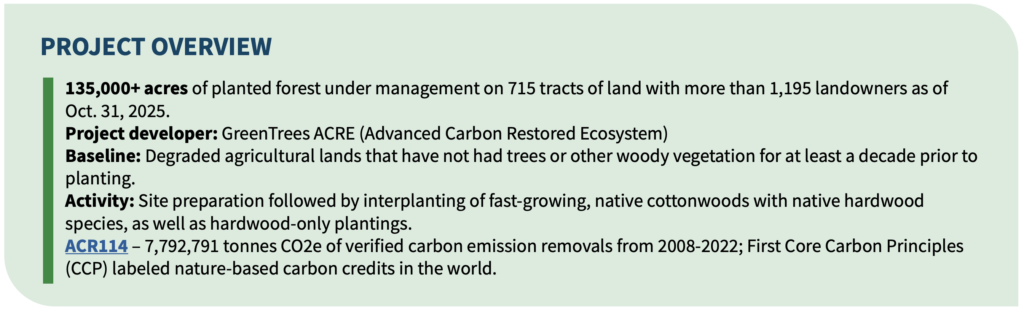
Founded in 2003, GreenTrees is the longest running forestry project approved by ACR. The project aggregates small tracts of land – ranging from 4 acres to 3,500 acres and averaging 200 acres – into a single carbon project. Today, the project covers nearly 140,000 acres.
To be eligible, landowners enroll lands that are degraded and are expected to remain degraded in the absence of the project. GreenTrees plants native species, such as sweet pecan, green ash, sweet gum, eastern cottonwood, bald cypress and various oaks, on these lands to sequester carbon and contribute to an ecosystem with broad environmental benefits.
As of 2025, GreenTrees represents 99.7 percent of all issued reforestation credits in the U.S. Credits from the project have been sold to Norfolk Southern, Mars, Microsoft and Duke Energy, among others. More than 50 million trees have been planted to date, with a goal of planting 100 million by 2030.
“Trees grow like people, in small increments,” noted Van Voorhis. “It can take 20 years before a forest is built, which makes it hard for reforestation to gain access to markets.”
Making good on a promise to his dad
Herbert “Trae” Banks remembers hunting in forests of the Mississippi Alluvial Valley as a boy, before high prices caused much of the area to be converted to soybean farms. Once thriving areas with ducks, deer, rabbits and more were cleared for new farms. Over time, as the soil fertility declined and soybean harvests faltered, much of the land “turned into a tax nightmare,” according to Banks.
As the soybean farms declined, Banks’ dad was able to buy tracts where his family had once hunted. Before his father passed away, Banks had promised him, “that I would have the ground back to its natural habitat, back to what it was like when he was a child. If I told my father I was going to do something, I would do it.”
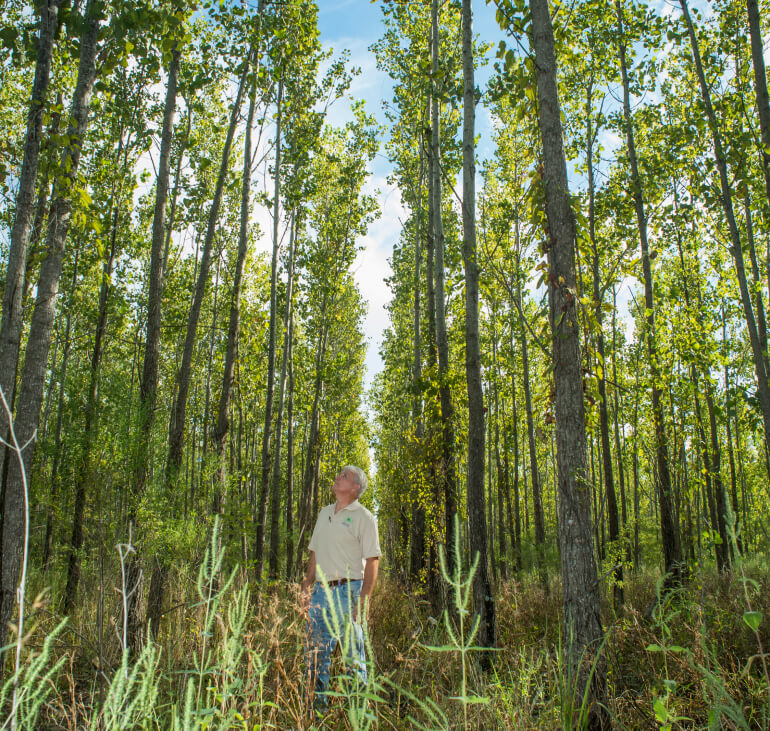
Today, Banks has nearly 1,000 acres across three tracts in GreenTrees. With trees planted in 2012, “the cottonwood is thriving, with the hardwoods riding behind,” said Banks. This is one of the keys to GreenTrees reforestation approach: interplanting fast-growing cottonwoods with native hardwood species that grow more slowly. Cottonwoods can grow 8-12 feet per year, acting as “nurse” trees to accelerate the growth and quality of the forest and creating wildlife habitat within a few years of planting. According to peer-reviewed research in the journal Restoration Ecology, “because of benefits conferred on breeding birds, we recommend reforestation of bottomland hardwoods should include a high proportion of fast-growing, early successional species such as cottonwood.”
According to Banks, the cottonwoods changed things quickly. The new trees, “gave wildlife a place to refuge and shaded areas.” Banks could see the land returning to its natural state, as he had promised his dad. “This land is my family history, it’s an heirloom.”
Pioneering reforestation in the U.S.
Prior to European settlement, the United States had more than a billion acres of forest. According to the U.S. Forest Service, more than 250 million acres of that forest have been lost in the years since. To address this loss, ACR published its Afforestation and Reforestation of Degraded Lands methodology, with a goal of using carbon markets to finance forest restoration. While the methodology has primarily been used in the U.S. to date, it has the potential to be applied globally.
Because reforestation tends to happen in small increments, ACR’s methodology allows for programmatic, aggregated approaches like the one GreenTrees uses. While it would be difficult for an individual small landowner to access the carbon market, given the costs of project development, tree planting, measurement, reporting, verification and more, it is much more efficient when these costs and activities are shared across properties within a programmatic project, like GreenTrees.
While the U.S. Department of Agriculture has programs to plant trees, they do not require long-term, legally binding commitments to keep them standing over time. Nor do they cover all aspects of successfully restoring a forest, from site preparation to ongoing monitoring. Research shows that private landowners, even when leveraging grant funding, typically bear extra costs and operate at a net revenue loss for decades. The additional costs of performing long-term afforestation and reforestation activities, such as vegetation management, silvicultural treatments, carrying costs of the land and more, incur further debts for landowners. With a minimum 40-year commitment, ACR’s methodology was designed to address these gaps in the market.
“GreenTrees has really pioneered reforestation in the United States,” said Dr. Kurt Krapfl, ACR forestry director. “They bring a professional forestry team to help ensure the trees planted survive and thrive.”
The act of planting a tree is just the beginning. In the Mississippi Alluvial Valley, during the first 10 years, the trees lay down roots. It is in the next 10 years that a forest starts to take shape. The majority of the carbon sequestration occurs in the later years when the trees are larger, so it’s critical to ensure they survive. “GreenTrees is showing what it takes to restore America’s largest river valley” Krapfl noted.
Convincing a skeptic
Back on the Womack Farm, the trees are taking root. Wildlife has moved back in, attracted by the newly growing forest and a small pond the family added. Ducks, doves, deer and other species are now flourishing on the property.
While Janie Cater is naturally skeptical, she has been convinced about GreenTrees. “They have done what they said they would do,” she noted. As the trees grow larger, Cater thinks about her legacy.
“I won’t live to see this forest reach maturity, but my children and grandchildren will. You have to start somewhere.”
For more information about the GreenTrees Advanced Carbon Restored Ecosystem (ACRE) Project, visit GreenTrees or ACR.
Related Projects