Insights from Winrock’s Lucy Jodlowska on the “Future of Food” at the Global Solutions Summit
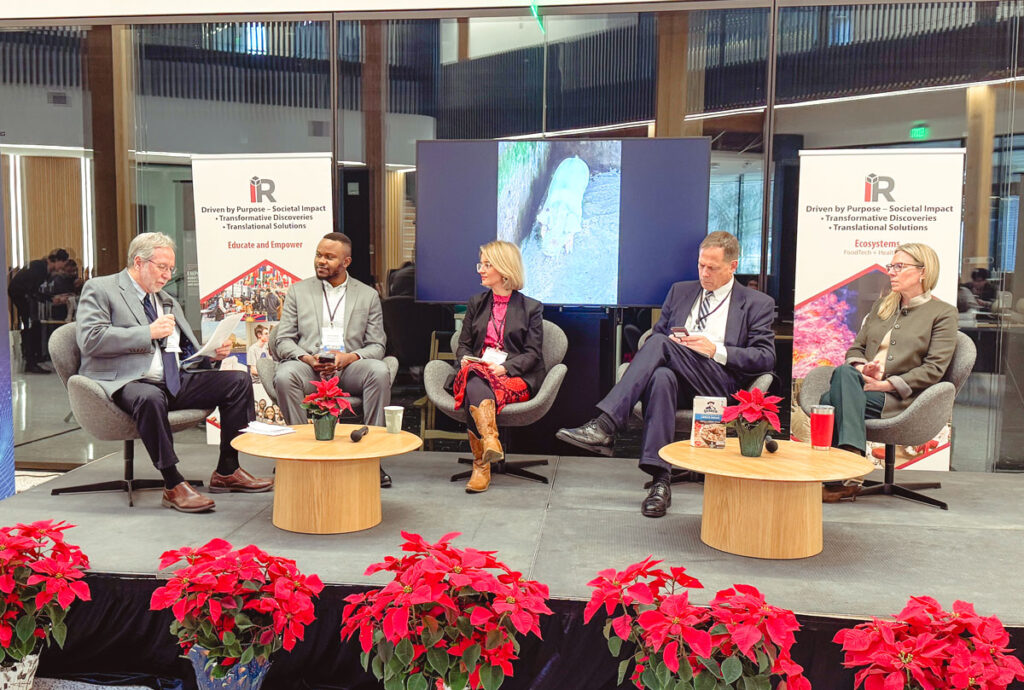
At the 2025 Global Solutions Summit on the Future of Food, hosted by the University of Arkansas’s Institute for Integrative & Innovative Research (I³R), global leaders and innovators explored how technology and collaboration can transform food systems. Among them was Lucy Jodlowska, Winrock’s senior director of U.S. Programs, who joined a high-impact panel to emphasize that resilience starts with access — to capital, innovative technology and partnerships.
Jodlowska shared Winrock’s model of blending seed funding with concessional loans, grants and private-sector engagement to help farmers boost productivity and withstand shocks. Her insights echoed the summit’s core themes: scaling breakthroughs in tech-supported farming, cellular agriculture and sustainable supply chains through investment and cross-sector collaboration.
“Where we can come in is as a partnership, bringing the right kind of capital.” — Lucy Jodlowska, Senior Director of U.S. Programs, Winrock International
That perspective, shared by Lucy Jodlowska, Winrock’s senior director of U.S. Programs, set the tone for a panel at the 2025 Global Solutions Summit on the Future of Food, held Dec. 17, 2025 at the Institute for Integrative & Innovative Research in Fayetteville, Arkansas.
Speaking alongside panel chair Steve Darr of Peacework; Brian Barnett of The Barnett Company Inc.; Elizabeth McLaughlin, formerly of Westrock Coffee; and Kafuti Talahumbu of George Washington University’s Africa Trade and Investment Programs, Jodlowska acknowledged the significant challenges facing international development over the past year. She noted that while the changes presented harsh realities, the traditional development model “was overdue for a change” — acknowledging criticisms while recognizing the painful transition ahead.
Jodlowska expressed strong optimism about Winrock’s position moving forward.
“It’s going to be painful, but I think that as a sector, we’ll be able to create something new and more sustainable,” she said. “We have a long history of working closely with the U.S. government,” she added, alluding to Winrock’s decades-long mission of strengthening economic growth, sustaining natural resources and safeguarding vulnerable populations.
Brian Barnett agreed with Jodlowska’s framing, noting she “gave a brilliant explanation of international development, where it started and where we are.” The panel discussion that followed revealed a sector in transformation — one moving from aid-based models to partnership-driven approaches that blend private capital, technical innovation and local empowerment.
Crowding in capital, building partnerships
The panel’s central theme emerged quickly: Effective development requires diverse capital sources and genuine partnership rather than top-down assistance. Jodlowska detailed Winrock’s approach of working with local and international financial institutions to facilitate seed funding while bringing additional resources through grant-based payments, concessional loans and foundation partnerships.
“When we do technical assistance, we work with the private sector to provide new technologies, technical assistance to increase agricultural productivity,” Jodlowska said. “When you increase productivity, you work on increasing farmer livelihoods, increased outputs — and sustainability is inherently at the core of that model.”
Capital innovation proves essential in contexts where interest rates reach 20-30%, effectively locking local entrepreneurs out of traditional financial systems.
Talahumbu reinforced this reality, describing the World Bank-supported endowment his organization established to address Africa’s financing gap. A three-pronged approach: research to inform policy; ministerial training during World Bank/IMF meetings; and conferences that bring American investors directly to African development bank convenings, exemplifies the connective infrastructure the sector needs, he said.
Jodlowska emphasized Winrock’s role as a backbone organization, bringing not only funding but also technical expertise to create lasting change. She pointed to the organization’s domestic programming, highlighting innovations like GrazeScape, a decision-support tool developed by the University of Wisconsin’s Grassland 2.0 Program in partnership with Wallace Center at Winrock International’s Pasture Project. The tool enables farmers in the U.S. Upper Midwest to input data on their farms and model different practices.
“Let’s say you have a 1,000-acre farm, and part of that farm is not productive and you’re trying to figure out: ‘How do I increase productivity yield?’” Jodlowska said. “You can input that data and look at — ‘What if I do x, y and z? What if I introduce rotational grazing? What if I do cover cropping?’ And model different scenarios of what your farm will do.” Farmers can then assess impacts on yields and productivity while decreasing nutrient loss through a free tool developed by Winrock through partnerships with academia and technology providers. (For more information and to access the tool, click here.)
The commercial case for transparency
McLaughlin, former executive vice president of sales at Arkansas-based Westrock Coffee, brought a practitioner’s perspective on how technology enables both accountability and profitability.
In 2009, Westrock’s founders, Joe and Scott Ford, began revitalizing a coffee mill in Rwanda. Since then, the enterprise has grown into a publicly traded company with nearly $1 billion in annual revenue operating across 35 countries. During the panel discussion, McLaughlin emphasized that doing business “the right way” delivers both ethical and financial returns.
“From an assured supply standpoint, from loyalty, from quality, from knowing we can trace our product to understanding the price and economics of it — this is why doing business the right way matters, but there’s math behind it,” she said.
Westrock developed basic SMS-based systems in Rwanda, using short text messages to communicate with farmers about coffee hedging and economic planning. The company evolved this into “Farmer Direct Verified,” a comprehensive traceability system now operating across seven coffee-growing regions worldwide.
Using digital tracking from washing stations through manufacturing, Westrock created QR codes on retail products at Walmart and Sam’s Club, allowing consumers to scan and learn when the coffee was grown, who harvested and processed it, and to read stories about specific farmers — creating transparency from farm to cup.
“We started developing an agronomy training program” that became the foundation for sustainability practices that other major companies and organizations now use, she said.
Confronting systemic barriers
Barnett brought the conversation to uncomfortable but necessary territory: the cultural and structural conflict embedded in many systems. “If you’re in one clan or one tribe or one political party, and the other party is in power, food becomes a weapon,” he observed.
His decades working on privatization in former Soviet states taught him that technology deployment means little without addressing fundamental issues — from legal and banking reform to the mindset shifts that true market economies require.
He advocated for “shrinking the supply chain” by developing local seed companies and using simple high-tunnel greenhouses that refugee populations could build in a weekend for $200-500 rather than importing expensive technology.
From suppliers to entrepreneurs
Perhaps the most powerful reframing came from Barnett’s challenge to business models themselves.
Using a granola bar as his prop, he calculated that farmers receive roughly five cents from a $3 product. “What if there was a different business model where suppliers became part of our company — where we commit 5% of our profit to go through our suppliers?” he proposed. “Instead of those we call suppliers, now they’re entrepreneurs.”
McLaughlin’s Westrock model demonstrated this principle in action, engaging farmers as partners whose loyalty and quality control directly benefits the company’s supply chain security and market positioning. The company deploys AI tools — not to replace human judgment, but to better predict yields by country and origin, helping balance supply needs with fair treatment for farmers.
Moving forward together
The panel’s message rang clear: The future of food lies not in replicating outdated development models but in genuine partnerships that blend diverse capital, deploy appropriate technology, confront systemic barriers and transform suppliers into entrepreneurs.
As Jodlowska and the other leaders articulated, the solutions already exist in communities worldwide. The question is whether the development sector can remove its own barriers quickly enough to support them — a challenge the panelists appear well positioned to meet.
Related Projects