The Climate Q&A with Rajesh Bista: Building the systems countries need to protect forests at scale

Rajesh Bista is a senior specialist with Winrock International’s Ecosystem Services team specializing in forest carbon accounting, Reducing Emissions from Deforestation and forest Degradation (REDD+), restoration and geospatial analysis. Trained as a geographer, he works with governments and development partners to strengthen the technical systems needed to measure, monitor and verify emissions reductions from forests and land use. His experience spans community-based forest management, climate change mitigation and adaptation, and the design and implementation of jurisdictional and project-scale forest carbon programs across Africa, Asia and Latin America. His work focuses on the intersection of land use, forests, local livelihoods and climate change, helping countries translate complex data into practical strategies that protect ecosystems, strengthen communities and create economic opportunities.
Bista traveled to Quito, Ecuador, to support government partners preparing for the validation and verification of the country’s national REDD+ program. Through hands-on training and technical assistance, Winrock is helping Ecuador strengthen its carbon accounting, monitoring and verification systems while advancing REDD+ nesting and climate finance readiness. This work helps ensure that efforts to protect forests are credible, transparent and aligned with international standards, creating a stronger foundation for attracting investment and scaling climate action.

You supported a training mission in Ecuador focused on forest protection and climate finance. What was the goal of that work, and what were you helping the government there prepare for?
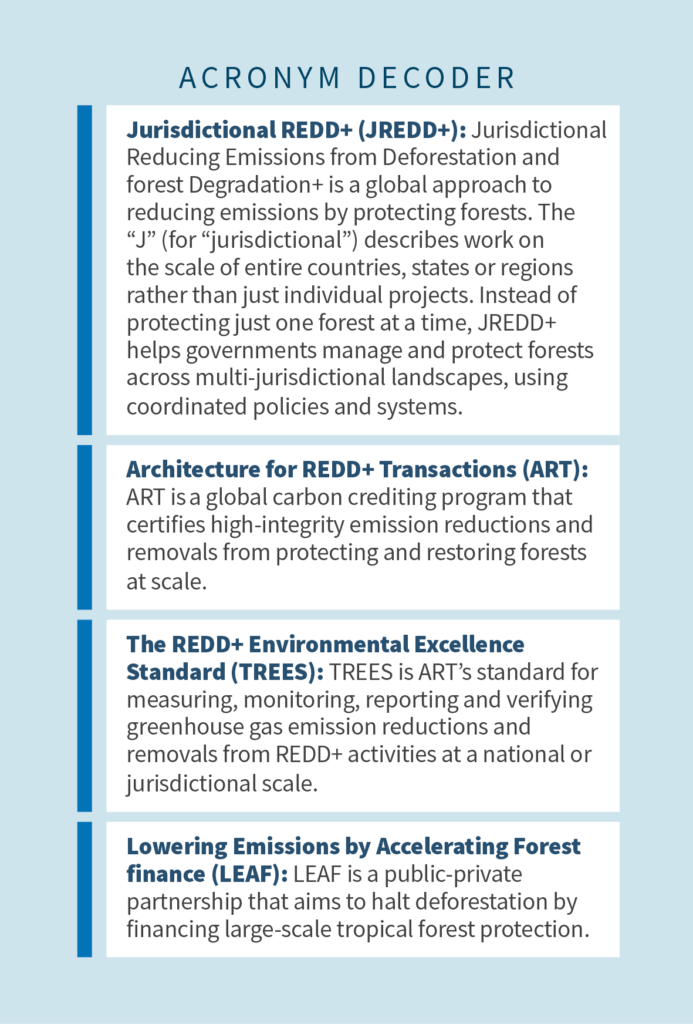
In February 2026, we supported a technical mission to Quito to help strengthen Ecuador’s readiness for the upcoming validation and verification (auditing) process under The REDD+ Environmental Excellence Standard (TREES). Funded by the UK government’s Technical Assistance Program for the LEAF Coalition, Winrock focused on delivering targeted, hands-on training to the technical staff of Ecuador’s Ministry of Environment & Energy. It’s part of a broader effort to help countries protect forests and reduce emissions in a way that is credible, transparent, and aligned with international standards.
The primary goal was to build capacity in two areas that are critical for successful implementation of JREDD+ programs: preparing for the validation and verification process conducted by independent Validation and Verification Bodies (VVBs), and understanding REDD+ nesting fundamentals in order to guide country to develop a strategy to diversify their REDD+ strategy. The nesting component focused on how project-level and jurisdictional activities can be integrated within a consistent accounting framework, while the VVB refresher sessions helped participants better understand audit requirements, common findings, materiality considerations, and how to effectively prepare for and respond to verification assessments. This was Winrock’s second VVB focused training dedicated to validation and verification in Ecuador.
More broadly, this work is part of an effort to help countries develop credible, transparent, and internationally recognized systems for measuring and reporting emissions reductions from forests. By strengthening technical capacity around carbon accounting, verification requirements and nesting approaches, Ecuador is better positioned to align local forest conservation efforts with national climate objectives and access results-based climate finance through high-integrity programs such as ART and the LEAF Coalition.
You mentioned “nesting.” What does that mean in the context of forest protection, and why does it matter?
Nesting is essentially about creating a coordinated framework for how different forest conservation and emission reduction efforts work together. In practice, it means integrating project-level REDD+ activities into a broader national or jurisdictional accounting system so that everyone is operating under a common set of rules and accounting principles.
We can think of nesting as the bridge between local action and national climate goals. Communities, private projects developers, Indigenous peoples and government may all be working to reduce deforestation or restore forests, but without a coordinated system, there is a risk that emissions reduction could be counted more than once, or that different programs could use inconsistent approaches for measuring results.
That’s why nesting is so important. It helps ensure that emissions reductions are accounted for consistently and transparently, clarifies how benefits and responsibilities are allocated among different actors, and strengthens confidence in reported results. These are all critical elements for maintaining environmental integrity and accessing high-integrity carbon markets and results-based climate finance.
For Ecuador, this topic is particularly timely. As the country advances its national REDD+ program and explores opportunities to integrate existing and future project-level activities, it is important to establish a clear framework for how these different efforts fit together. During the training, we focused on nesting fundamentals, including key principles, implementation models, accounting considerations, and lessons learned from other jurisdictions. Developing a shared understanding of nesting principles now provides an important foundation for Ecuador as it explores approaches to better coordinate project-level and national REDD+ efforts in the future.
What’s at stake if they get it right?
For Ecuador, nesting is essential to make sure that government-led JREDD+ programs and private-sector projects operate within a single, coordinated accounting framework rather than independently. This helps prevent double-counting of emission reductions, ensures consistency in how carbon credits are measured, enables participation in high-integrity carbon markets and strengthens transparency and credibility.
At the same time, alignment across carbon accounting approaches is critical. When project-level and jurisdictional programs apply consistent methodologies, they can can operate side-by-side in a complementary manner, reinforcing rather than undermining one another. This creates greater confidence that emission reductions are being measured, reported and credited accurately.
If implemented effectively, a nesting framework can help Ecuador scale up its climate and forest conservation efforts while meeting rigorous international standards. It also creates a strong foundation for attracting results-based finance and carbon market investment, enabling the country to secure funding for successfully protecting forests and reducing emissions.
What were some of the key things you walked through during your training with government staff?
Winrock’s training covered a range of technical and practical topics, with a focus on both bigger-picture concepts and day-to-day systems needed to implement them.
On the nesting side, we discussed some of the things we’re talking about right here, such as the purpose and relevance of nesting. We also reviewed different REDD+ implementation models and approaches, what’s needed to make nesting work in practice, and how to align activities at the different levels (at the project and jurisdictional levels).
We provided refresher sessions on validation and verification processes, including audit timelines, data completeness requirements, and the role of independent VVBs. Participants were also trained on how to interpret audit findings, assess risk and materiality, and respond to corrective action requests. The overall goal was to help participants understand not just the technical requirements, but how these systems fit together to support a functioning national program.
Can you tell us more about validation and verification?
The validation and verification process is critical because it ensures that the data behind a country’s climate claims is accurate and credible. It provides independent assurance that reported emission reductions are consistent with recognized international standards.
Our refresher sessions were designed to prepare Ecuador’s technical teams for the 2026 validation and verification cycle. We focused on strengthening their understanding of audit processes, materiality thresholds, and data completeness requirements. The goal was to help equip Ecuadoran officials to engage with independent auditors, respond to feedback and demonstrate that their systems meet international standards. We also discussed how to effectively interpret audit findings, manage risk areas and respond to corrective action requests in a structured and defensible way.
Building this type of technical and institutional capacity is essential. It helps ensure a smoother audit process, strengthens coordination across agencies, and supports the overall integrity of the reporting system. Ultimately, this is fundamental for Ecuador to be able to demonstrate compliance with international standards and to access results-based climate finance with confidence.
What else is Winrock doing to support Ecuador’s forest and climate goals?
We’re working closely with the ministry to support refinements to their MRV and carbon accounting systems targeted at their submission. The overarching objective is to support Ecuador in successfully completing an independent validation and verification audit and progressing toward the issuance of high-integrity carbon credits.
With regards to REDD+ nesting, this training is one component of a broader package of technical assistance aimed at helping operationalize REDD+ nesting framework. Alongside the training, several complementary efforts are ongoing.
From a technical and methodological perspective, we’re helping put together a dedicated report on the accounting side of nesting, and particularly, how to allocate and reconcile emission reductions across different projects and jurisdictions aligned with ART, TREES, and national monitoring systems. This helps ensure consistency and clarity in how results are measured.
On the policy side, we are helping to review Ecuador’s existing REDD+ policies and regulatory framework, and exploring pathways to strengthen and diversify the country’s nesting approach. This can help ensure that national frameworks support both environmental outcomes and participation from different stakeholders.
We’re also conducting geospatial analysis to understand forest cover under different tenures, and identifying priority areas for REDD+ activities to inform the design and implementation of future nesting strategies. Together, these efforts are designed to help Ecuador move from planning to implementation, and to build a system that is both technically sound and practical to apply.
Stepping back, how does this work contribute to climate progress and resilience more broadly?
At a big-picture level, it’s about helping countries protect forests, which are one of the most effective natural solutions we have for addressing climate change.
Forests absorb and store carbon, support biodiversity, and help communities adapt to changing environmental conditions. But protecting them at scale requires strong systems, from data and monitoring to policy and finance. By helping countries like Ecuador build those systems, we’re supporting climate mitigation by reducing emissions from deforestation while also strengthening resilience by promoting sustainable land use and long-term ecosystem health.
This kind of work also opens the door to new sources of financing that reward countries for protecting natural resources, helping to ensure that conservation efforts are not only environmentally effective, but also economically sustainable.
Your Winrock colleague, Pedro Piffer, was in Pará, Brazil, last summer for JREDD+ training with state government partners. How was that work similar to what you were doing in Ecuador?
There are a lot of similarities. In both Ecuador and Pará, we’re supporting governments as they move from planning to implementation of JREDD+ programs. That means helping them build the technical systems, data and processes needed to measure emissions reductions, meet international standards and ultimately, access climate finance.
In both cases, training is a key part of that work. Whether we’re in Ecuador, Brazil, or any of the other 10 countries where Winrock’s Eco team works on JREDD+ programs, we’re focused on strengthening local capacity. It’s about helping technical teams in these countries understand how systems work in practice and how to apply them in their own context. The goal is the same: to make sure countries and states have the tools they need to produce credible, verifiable results from forest protection.
At the same time, the context can be quite different. In Ecuador, the work is focused at the national level and on aligning different types of activities across the country into one unified system. In Pará, where Pedro has been leading efforts, the work is at the state level within Brazil’s broader national framework, and often involves engaging with a different mix of stakeholders and existing programs.
So, while the technical foundations are very similar, the way those systems are applied and the challenges they are designed to address vary from place to place. That’s why this kind of hands-on, tailored support is so important: It helps ensure that each jurisdiction can build an approach that works for its specific context while still meeting global standards.
Related Projects

Burkina Faso Technical Assistance and Capacity Building to Reduce Emissions from Deforestation and Forest Degradation
Burkina Faso is taking bold steps to combat deforestation and land degradation, which threaten ecosystems, agricultural productivity and rural livelihoods. Building on its long-standing commitment to sustainable land and forest management, the country is advancing a large-scale program to reduce emissions from deforestation and forest degradation (REDD+). This effort aims to generate verified emission reduction […]