

Five takeaways from Winrock International’s ethical supply chain leadership
Building resilience through responsible, rights-based approaches in business
By: Winrock International's Human Rights & Empowerment team
In an age of converging global crises — climate instability, supply chain shocks, human trafficking and other forms of exploitation — building resilient communities means more than economic growth: it requires deeply rooted respect for human rights. Winrock’s Human Rights & Empowerment team is playing a central role in shaping what resilience looks like for both people and the planet.
Across its portfolio, Winrock’s work brings together companies, governments, civil society, community leaders and other partners to operationalize ethical supply chains, reduce risk and build systems that protect human dignity while supporting sustainable livelihoods.
Recently, four leaders and technical experts from Winrock’s HRE team were invited to engage and share Winrock’s knowledge, approaches and strategy at important global forums not just as participants, but as active problem solvers. Here are five key takeaways from those engagements, and what they mean for the future of responsible business and resilient development.
1: Ethical supply chains are at a pivotal point — and trusted implementers and solutions are imperative
When Stephanie Lillegard, portfolio director of Winrock’s HRE team, attended the Responsible Business Alliance 2025 Annual Summit in Maryland, she heard firsthand how a wide range of industries are grappling with rising expectations across every link in their value chains. The annual RBA gathering — which covers electronics, retail, auto, toys and minerals — brings together companies, governments, civil society and intergovernmental organizations in a rare alignment of purpose.
“At a time when supply chains are at a crossroads, companies need more than good intentions — they need implementers who can translate high-level frameworks into local, trusted systems,” Lillegard said.
That’s where Winrock helps. Winrock’s decades of experience in labor rights, counter-trafficking and human rights due diligence mean its teams can help businesses establish transparency even in high-risk supply chains. Whether that’s working with local partners to eliminate child labor in the cocoa sector or developing grievance mechanisms and reporting systems so workers have protections and voice in the seafood industry, Winrock’s work bridges strategy and execution.
Winrock is not only putting mechanisms in place to mitigate risk, but building trust among companies, workers and communities to ensure social safeguarding measures are impactful and address real needs and risks along the value chain.
To further this approach, Winrock is proud to have joined the Accountability Framework initiative as a delivery partner, assisting companies to map and mitigate environmental and social risks across agricultural and forestry supply chains. Through this initiative, Winrock will support businesses in applying the Framework to their operations, helping them address environmental and social risks in agriculture and forestry supply chains.
2: Fair labor practices are essential to reshape sustainable commodity production
After visiting palm oil facilities and attending the 2025 RSPO Roundtable Conference on Sustainable Palm Oil in Malaysia, Winrock Program Manager Mike Kuncio emphasized a critical point: Real progress requires listening to the people most affected — those doing the hands-on work.
“I heard directly from migrant workers about their recruitment experience while in the field,” Kuncio said later about his engagement. “Their stories are essential. They influence how we design human rights due diligence systems.”
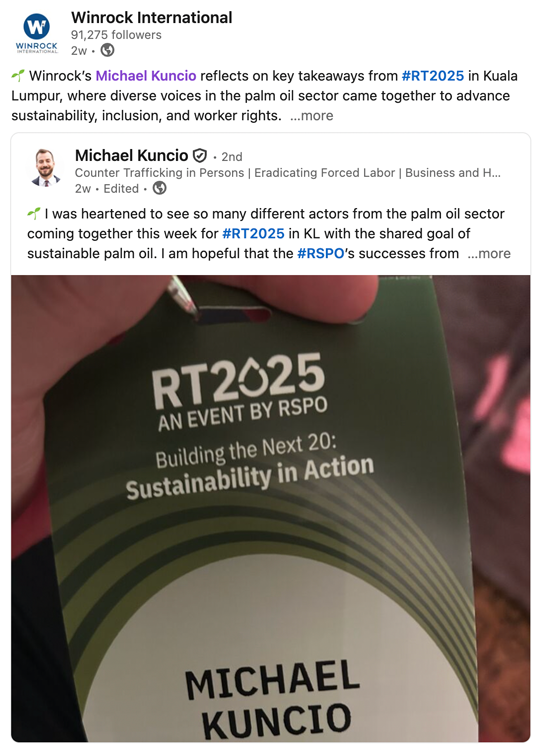
The global palm oil sector is massive, with production estimated around 75 million MTs per year, and approximate market value at over $74 billion and growing, according to recent reports. To help ensure sustainable, responsible growth, Kuncio spotlighted four higher priority areas for supporting fair labor:
- Reframing incentives so that certification rewards more than just compliance.
- Including commodity dealers — not just the growers — in human rights dialogues.
- Championing jurisdictional approaches and stronger worker access to unions.
- ️Centering the voices of rights holders in shaping sustainable solutions.
These aren’t just lofty ideas — they’re grounded in Winrock’s practical experience. Winrock’s work in palm oil and in other agricultural sectors aims to support companies in operationalizing ethical recruitment, reducing risk and strengthening worker well-being, all of which contribute to long-term resilience for both communities and environment.
For more information on Winrock’s private sector partnerships, click here.
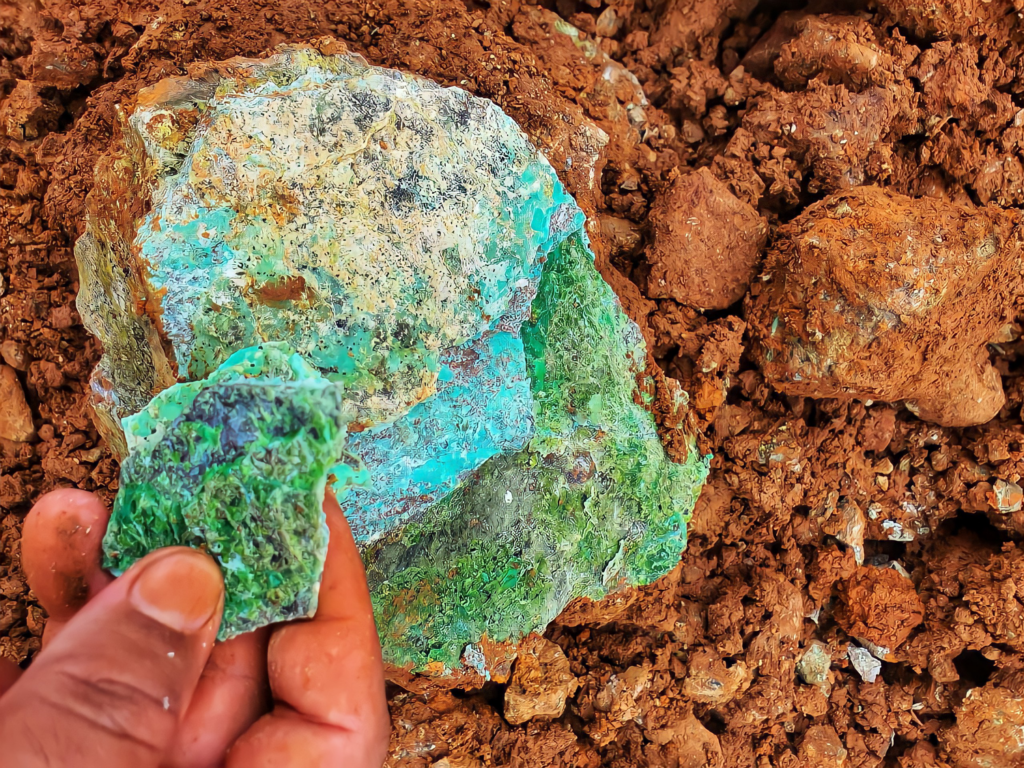
3: The global scramble for critical minerals demands labor rights as a core pillar
Olga DiPretoro, technical advisor on Winrock’s HRE team, spoke at BSR’s Building Responsibly Forum on worker welfare in the construction and engineering sectors. The forum emphasized that worker welfare is key for business continuity in addition to legal compliance with responsible sourcing frameworks.
DiPretoro highlighted key labor issues spanning the sectors, including: strategic minerals such as cobalt and nickel mining and processing; child labor; informal migrant labor; debt bondage and illegal recruitment fees; long hours and sub-standard health and safety practices; high injury and fatality rates; harassment of female employees; and exploitation and forced labor.
“Worker welfare and labor monitoring aren’t optional — labor rights are business-critical where supply chains intersect with the energy transition,” DiPretoro said after sharing some of Winrock’s approaches at the forum. While international due diligence legislation is evolving, consumers and investors demand data and verification that products are produced in a socially and environmentally responsible way.
Winrock helps companies build independent, locally driven grievance mechanisms, facilitates trust-based dialogue, and provides mediation and counseling so that workers are supported, not exploited, DiPretoro explained.
4: Digital innovation is a frontline defense against exploitation — but trust must be paired with services
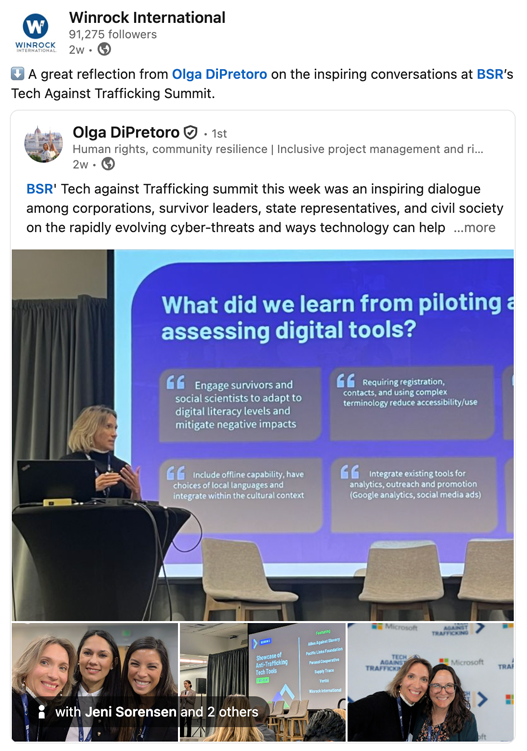
At the BSR Tech Against Trafficking Summit in San Francisco, Winrock’s DiPretoro spoke directly to tech-savvy participants about how technology and human rights must work hand-in-hand, and should always connect to services, policy frameworks and real people who need help.
Winrock is already doing this. Through its counter-trafficking work, Winrock has worked with partners to develop digital tools like chatbots and early-warning systems to detect exploitation risk. As just one example, Winrock helped deploy the Migrant.kg platform in the Kyrgyz Republic. The platform serves as a virtual consultant on regular migration channels, migrant rights, verification of licensed recruiters, and contact information of service providers. The platform has been used hundreds of thousands of times for real-time protection.
Looking ahead, DiPretoro said she’s excited to see how these discussions and new technologies will help advance:
- AI-powered warning systems to disrupt online exploitation and detect risks patterns using company, worker and contextual data;
- Progressive policies, more effective referrals and services that must mirror the data and ensure protection of affected populations; and
- Sharing of cyber expertise by tech companies and experts with state and non-state actors in emerging economies to respond to escalating online threats.
Adopting a human-centered digital approach ensures that when risk is identified, it is met with real-world support, not just datapoints.
5: A just energy transition demands community leadership, not just traceability
In London, Winrock’s Holly Scala, a senior program officer, participated in the Critical Minerals Innovation Forum. Her post-event reflections emphasize that traceability alone — knowing where a mineral comes from — is not enough.
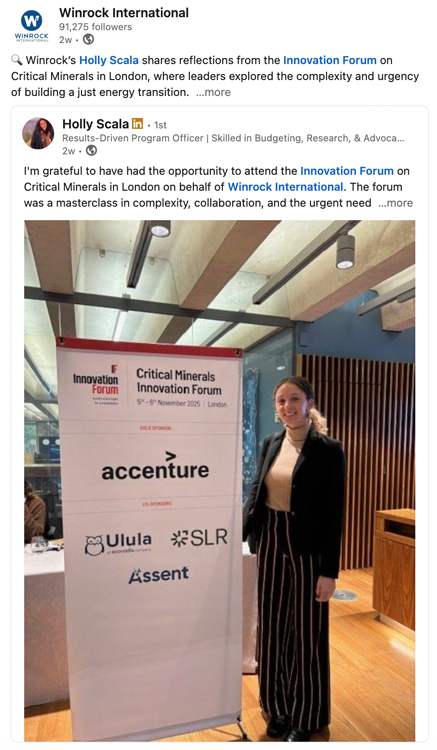
“Traceability ≠ ethics,” Holly wrote after attending the event. “It’s not just where materials come from, but how they’re sourced that matters. Communities must be centered — standards only work if shaped by those most affected.”
Scala also underscored the importance of engaging mining host communities even before projects begin, regulatory support for smaller suppliers, and grievance tools rooted in community trust.
Winrock is advancing these approaches by partnering with stakeholders to design and deploy grievance mechanisms, engage worker voice tools, and build community-led systems that prioritize dignity and rights.
These are key parts of Winrock’s broader strategy to support human rights, sustainable business, and build community and environmental resilience.
Why it all matters — for people and our planet
Ethical recruitment and fair labor systems protect dignity and reduce exploitation. Resilient supply chains are less vulnerable to reputational, legal and operational risks. When communities are supported and protected, sustainable production becomes more stable and efficient — whether in agriculture, the tech industry, mining or forestry.
As digital technology, the energy transition and climate-smart production practices rapidly reshape global systems, Winrock is playing a leading role in ensuring that the shift is not only green, but also just — with long-term resilience baked in. If you represent a company, government or civil society partner looking to embed ethical practices into value chains, we’d love to talk. Let’s build durable, responsible solutions — together.
Click here to learn more about Winrock’s Social Impact Services for Business.